Velvet Horizons · Cultural Dispatch
The Tradition I Wish
the Mainland Had:
Meet the Moko Jumbie
On the question every traveler eventually asks — and why my answer is ten feet tall, dressed in madras, and dancing on stilts.
USVI Culture Island Life African Heritage“What’s a cultural tradition from another country that you wish existed in yours?”
It’s a beautiful question. And the kind of traveler who asks it is usually either standing in a piazza at midnight watching something they’ve never seen before — or, in my case, standing on a Caribbean hillside trying to decide between two properties and getting absolutely sideswiped by a ten-foot stilt walker in a sequined costume.
I’m currently house-hunting in the US Virgin Islands. And yes, technically that’s still the United States. But let me be direct: the USVI is not the same America you grew up in. The rhythm is different. The colors are different. The relationship between a community and its celebrations is something the mainland — bless its strip malls and parking lots — has largely forgotten how to do.
The tradition I wish existed everywhere? The Moko Jumbie.
Who — and what — is a Moko Jumbie?
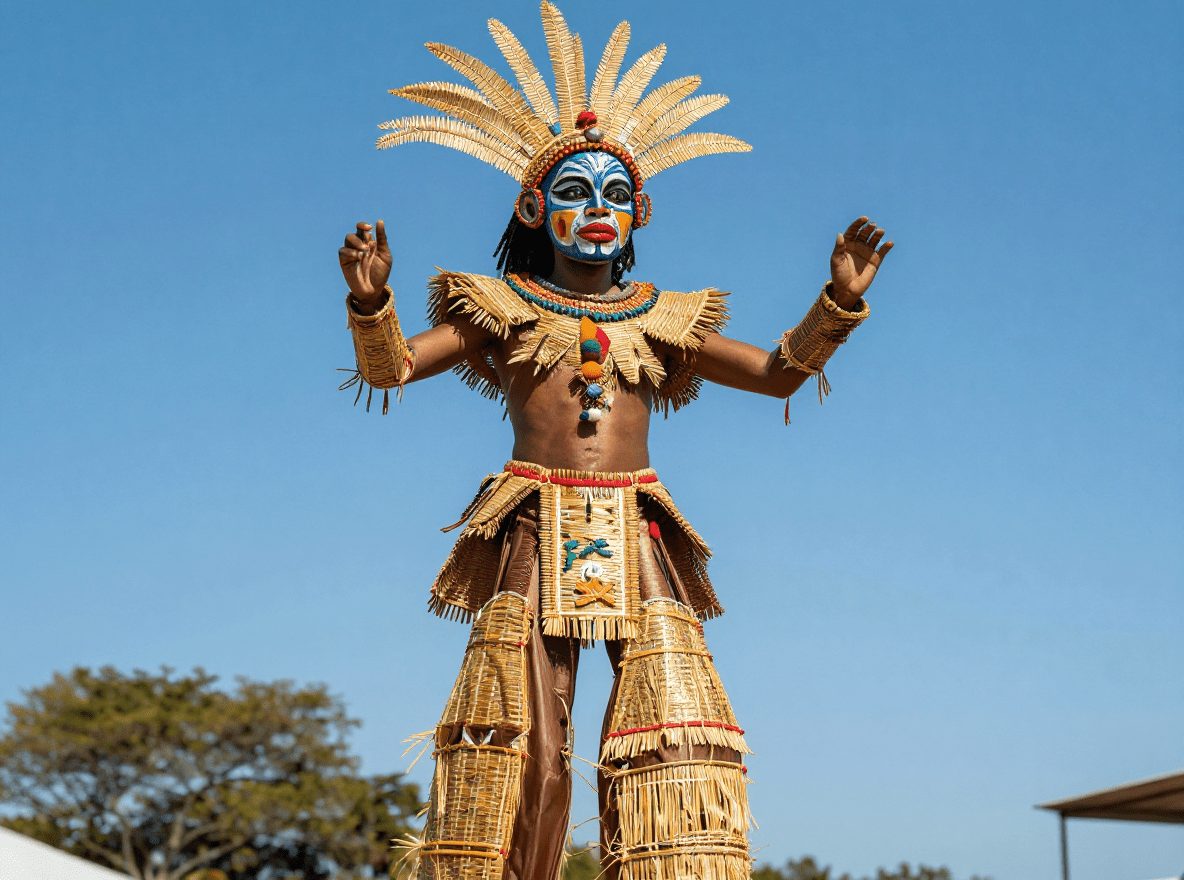
Picture this: a figure moving through a carnival parade at ten feet tall — sometimes taller — dressed in the official madras print of the Virgin Islands, all bright turquoise and gold and royal blue. Stilts hidden beneath flowing fabric. Moving with an ease that makes absolutely no mechanical sense. Dancing. Dipping. Greeting children eye-to-eye from a height that should make balance impossible.
That is a Moko Jumbie, and they have been a fixture of Caribbean celebration for over 200 years.
◆ What’s in a name?
“Moko” comes from Central Africa, where it means healer — or, in some traditions, diviner. “Jumbie” is the Afro-Caribbean word for ghost or spirit, likely derived from the Kongo word zumbi. Put them together and you get: a healing spirit. A guardian ghost. A protector who stands tall enough to see danger before it arrives.
The tradition was brought to the Caribbean by enslaved Africans, rooted in West African — particularly Yoruba and Igbo — spiritual practice. The towering height was not theatrical choice. It was cosmology. Height meant proximity to the divine. The Moko stood above the village not to be seen, but to see — to watch over the people below and ward off evil before it could take hold.
A tradition forged through resilience
The oldest written record of a Moko Jumbie dates to 1791 — a description by William Young of “moco jumbos” in St. Vincent. That’s not just old. That’s revolutionary-era old. These figures were moving through Caribbean streets while the ink was barely dry on the U.S. Constitution.
What makes the Moko Jumbie extraordinary is not just what it is, but what it survived. A spiritual tradition maintained in secret, folded into carnival as a way of keeping it alive, passed generation to generation through the bodies of dancers and the hands of stilt-makers. It didn’t fade. It grew. It became the official symbol of USVI tourism. Children as young as five train in the art.
“The Moko Jumbies that appear in our Carnival celebrations are always synonymous with protection.”
— Gabrielle Querrard, USVI native and cultural ambassador
Today, Moko Jumbies appear at every major celebration across St. Thomas, St. Croix, and St. John — Jump Up carnivals, Christmas festivals, independence celebrations. Men, women, and children of all ages perform. The costumes blend African roots with Caribbean color: plaid fabrics, feathers, sequins, elaborate masks, and always, always, that signature madras print.
So why do I wish the mainland had this?
Because the mainland has largely traded its communal rituals for content. We livestream experiences we used to show up for. We Instagram the parades we used to join. There is something the Moko Jumbie tradition does that a trending sound on social media simply cannot: it puts a body in the street. A human being, trained for years, balanced on faith and muscle memory, moving through a community that recognizes what they represent.
There is also the matter of what the Moko Jumbie means. A guardian. A healer. A spirit standing watch. In a world that has no shortage of things to be anxious about, I find something genuinely comforting in the idea of a cultural tradition whose entire premise is: we are being looked after.
I’m shopping for a home here. And every time I see a Moko Jumbie appear at the edge of a parade, I feel — not metaphorically, but actually — like whatever island I end up on has been watching over me long before I arrived.
◆ Where to witness the magic
St. Thomas Carnival — April. The biggest in the USVI, a weeks-long eruption of color, soca, and stilt dancers towering over Charlotte Amalie.
Jump Up, St. Croix — Four times a year in Christiansted. Moko Jumbies parade by night through streets lit by steel pan and torchlight.
Crucian Christmas Festival — December through January. The island of St. Croix ends the year wrapped in African heritage, Caribbean rhythm, and yes — Moko Jumbies at midnight.
The question was: what tradition from another place do I wish existed in mine? My answer is a ten-foot guardian spirit in a sequined madras costume, trained since childhood, dancing through streets that smell like rum punch and sea air.
And as it turns out — if you pick the right island to call home — you don’t have to wish. You just have to show up.
Velvet Horizons is a travel journal about living slowly, moving intentionally, and finding the places that feel like they were waiting.
Currently somewhere between a closing date and a very long stilt-walking lesson.


Discover more from Velvet Horizons
Subscribe to get the latest posts sent to your email.

