There are mornings that feel like silk brushing against the soul. Today was one of them. I woke with a smile that did not belong to sleep. A beautiful conversation still lingered in my mind, a man’s voice rich and warm, with that slow, Creole ease that turns ordinary syllables into something tender. We had spoken about nothing and everything: laughter that arrived without reason, childhood memories that tasted like sugar and summer water, little philosophies about timing, patience, and luck. I will not tell all the details, but he had eyes that noticed too much and exactly enough. His laughter wrapped around me the way good jazz curls through a dim room at two in the morning.
When the call ended, the silence that followed felt like an embrace. The city breathed with me. From the balcony, birds arranged a rhythm only New Orleans can keep, those quick trills and soft pauses that sound like flirtation. The air was sweet and alive, salted by the river, perfumed by petals, humming with distant sounds: a cart rolling over cobblestone, a horn warming up, a coffee grinder singing its little metallic song. October light slanted across the street so gently that even the shadows felt kind.
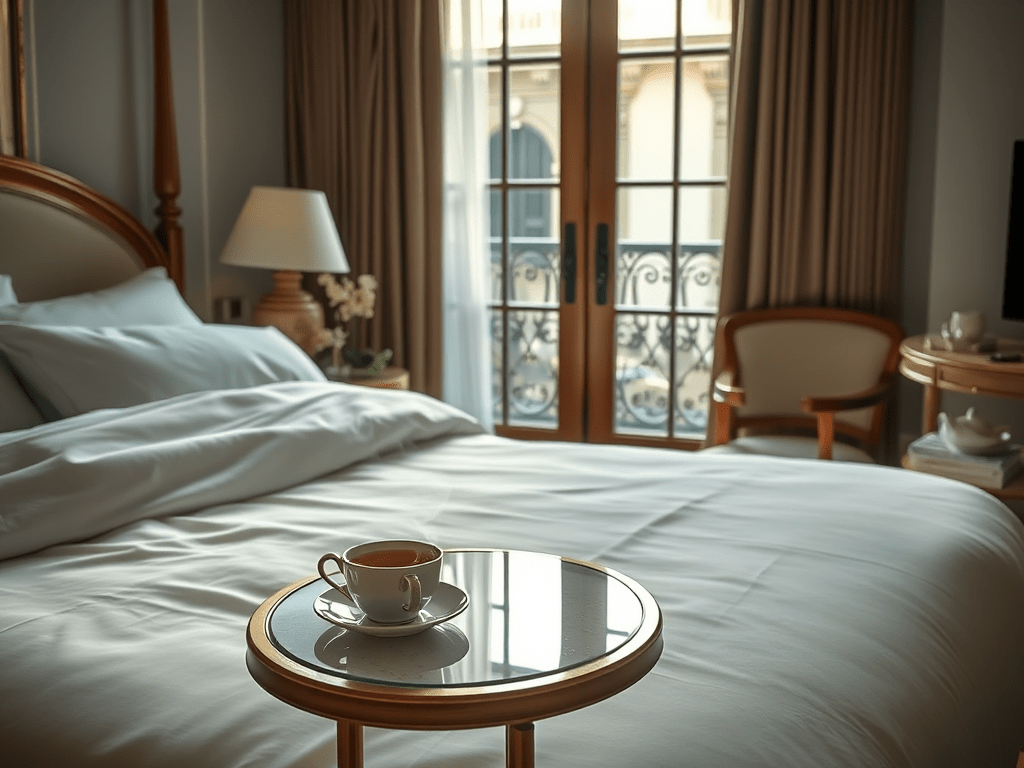
Inside, the hotel room held its own hush. The sheets were crisp; the room smelled faintly of jasmine tea, orange peel, and polished wood. Morning sun slid across a framed mirror and made the edges glow. Beauty like this does not shout. It whispers. It reminds you that comfort and desire belong in the same breath. I let the window crack open for a hint of cool air, then pulled the duvet to my waist and laid there for a long minute, listening to my heartbeat settle into the city’s tempo. Abundance, I decided, is not more; it is presence. It is the way light lifts a corner of a room and makes it feel like a promise.
A Mirror Named Florence
I thought of Florence Scovel Shinn as I sipped my tea. Her sentences have followed me across years, tugging me back to center whenever I drift. She said that life mirrors what we believe we deserve. Sitting there, wrapped in quiet luxury, I understood her completely. The first sip tasted like honey and patience; the second tasted like permission.
Abundance is not luck; it is a language. It is an agreement with the universe that says, “I am ready to receive,” and then proves it by noticing. It means finding beauty where others see repetition, trusting that what you call in is already on the way, and remembering that luxury begins as a mindset long before it becomes a lifestyle. A gold morning does not need to announce itself; it arrives on tiptoe and leaves fingerprints on your senses.
This day was my small pilgrimage into that truth. A day trip to the French Quarter to be unhurried, to write, to be pampered without apology. The hotel felt like it had been waiting for me: marble floors cooled by shade, a chandelier scattering coins of light across the lobby, velvet seats that remembered every body that had rested there. The walls had a hush I associate with old churches and old money. If I leaned in, I could almost hear the stories they kept.
Florence believed gratitude was the law of increase. Every thank you opens another door. So I named my thank yous out loud, as if varnishing them made them shine more: the tea steaming against my palm, the quiet, the scent of the morning, the playful echo of his voice, the patient gleam of the chandelier, the slant of autumn light that made gold of everything. It felt like tending an altar. Even when nothing grand happens, noticing is its own miracle; it shifts the room inside you where blessings like to sit.
Royal Street and the Art of Motion
By noon, the city called me with a voice I could not ignore. The mist had lifted, leaving the streets polished and pleased with themselves. The colors of the Quarter held their breath, then laughed: pink stucco and ochre walls, green shutters and rust balconies, all layered with the patina of heat and history. Somewhere nearby a saxophone tested a low note, then another, the sound simple and confident. It felt like a wink.
I wandered down Royal Street, where galleries glitter like treasure chests and every window says look at me without shame. In one glass pane, chandeliers hung like frozen fire. In another, antique mirrors flashed in the sun and multiplied the day. A little gust from the river lifted the hem of my skirt and cooled the back of my knees. October teased and then soothed, like fingers tracing a secret down the spine.
Inside a narrow gallery, the air smelled of turpentine, lemon oil, and time. I paused in front of a canvas that had its own weather: blues and golds swirling as if the paint had remembered a dream. The artist sat behind a counter with cobalt on his wrist and a smile that did not hurry. He looked at the painting, then at me, and said, “I paint energy, not scenery.”
“You can tell when something is alive,” I said.
He nodded. “Then you are one of us.”
A couple entered laughing, and the bell on the door chimed a polite little song. I drifted back into the sunlight where a fortune-teller adjusted her scarf and a juggler tossed three apples as if gravity worked for him personally. A trumpet caught a melody and a child clapped in that brave, offbeat way children clap. As I crossed to the next block, a man leaned from a doorway and called, “Baby, you smell like magnolia and money.” He said it with admiration, not greed. I laughed; the wind stole my laugh and carried it to the corner.
A few doors down, a handsome Creole man with salt at his temples and a caramel voice offered me a sample of pralines. His hands were beautiful, quick and careful. He watched my face as I tasted, as if waiting to see what desire does when it first wakes. The candy broke soft, then melted, sugar and pecan and butter closing around me like a kiss. He smiled and said, “You are a first bite person.” I asked what that meant. He said, “Some people nibble life. Some people bite it and let the sweetness run.” His eyes did that lingering thing. Mine returned the favor. The air between us warmed. He tucked an extra piece into the bag and whispered that October brings good luck to women who know what they want. I told him I would test his theory and report back. He laughed, a sound like light on brass, and bowed as if we had made a pact.
Jackson Square: The City’s Heartbeat
The cathedral rose ahead like an exhale held for a century. Around Jackson Square, life rearranged itself into color and sound. Artists fastened canvases to wrought-iron fences. Brushes moved with the confidence of habit. Tourists clutched iced drinks and maps. A street musician tuned his guitar to a key that could heal almost anything. Someone nearby sold beignets, and a gust of sugar scent lifted the mood by three degrees.
I found a bench near the fountain, smoothed my skirt, and let my shoulders fall. The air was thick with flowers and coffee and a sweet praline echo from my pocket. A little boy jumped through puddles with the conviction of a sailor, while his mother called his name in a tone that blended love with warning. Two strangers began to dance to a busker’s trumpet; their feet argued, then flirted, then negotiated. The city watched them as if they were a necessary ritual.
A tall Creole man in a linen shirt sat at the far end of my bench, leaving a respectful space that did not feel like distance. He smelled faintly of cedar and citrus. His accent turned simple phrases into invitations. He asked if I believed in fate or if I preferred the word timing. I said both are useful, but timing keeps a better calendar. He laughed softly, turned his head to look at me fully, then let his eyes drift to my mouth before returning to my eyes. The pause that followed was not awkward. It was charged. He said, “You wear peace like it fits you,” then added, almost to himself, “and trouble like it knows your name.” I told him he could not put both on the same receipt. He said he would try. We shared a grin that lasted a second longer than strangers are supposed to allow.
A guitarist began an old blues tune that knows its way around a wound. I felt Florence rise in my thoughts again. Your word is your wand. The city seems to know this; everything here declares itself. Even the pigeons strut like poems with tiny feet. The man beside me stood, touched two fingers to his heart, then to the air between us, as if blessing the space we had borrowed. He left without asking for my number. That restraint made the moment perfect.
The Sacred Hour of Writing
By mid-afternoon, the hotel lobby cooled my skin the way mint cools a tongue. Lemon oil and old wood softened the air. Somewhere near the bar, a pianist unspooled a melody that felt like silk pulled through impatient fingers. I ordered an espresso and opened my notebook. The first line arrived without force; the second followed as if it had been waiting at the door. There are days when work feels like lifting a stubborn anchor. Today the words floated.
Abundance behaves like a river that prefers not to be chased. The more I softened, the more it gathered around me. I wrote about gratitude and alignment, about how plenty is less a pile and more a current. I wrote a line about the praline man’s hands and then scribbled it out, then wrote it again, then underlined it, since some details deserve their own attention. The Creole voice from the morning returned; I heard a strand of laughter inside it and smiled at my page like a woman with a secret.
A woman in a red dress passed the window singing to herself. She carried a basket of orchids as if escorting royalty. Even that small procession felt like theatre. In this city, performance is not confined to the stage; the sidewalk is a rehearsal hall, the curb a front-row seat.
The pianist found a minor key that brushed my ribs. I changed pens, the way a dancer changes shoes, and the next paragraph transformed into something with hips.
The River’s Lesson
Toward evening, I walked to the river. The Mississippi stretched wide and sure, a body with memory. The water caught the sun and tossed it back in coins. A breeze lifted the hair at my neck and encouraged me to stand closer to the rail. I obeyed. The rail was cool. The world smelled like damp wood, metal, and a hint of citrus from someone’s drink. A steamboat horn murmured somewhere to my left, mournful and amused at once.
The river teaches without explaining. It never hurries. It never justifies. It moves with authority born of endurance. Watching it, I felt the knowing Florence always wrote about. She said that worry blocks the door; the miracle needs a clear hallway. I let three old concerns slide off the edge of the day and imagined them drifting away like leaves. The water did not argue. It accepted everything and kept moving.
A vendor near the steps whistled, then offered a cup that sparkled with shaved ice. “Where you headed, pretty lady?” he asked, eyes kind, voice teasing.
“Nowhere,” I said. “That is the beauty of it.”
“Best place to be,” he replied, tipping his cap. He gave me a little extra syrup as if victory should be sweet.
When I turned to go, a jazz trio struck up a tune that put sugar in my knees. A pair of lovers leaned against the railing and forgot the rest of us existed. The sky became a ribbon of copper. The city, pleased with its reflection, lit its lamps.
Dinner on Chartres Street
The evening smelled like garlic, butter, and rain coaxed from stone. I wandered into a café on Chartres Street, the kind with ferns that spill from baskets and candles that give every cheekbone a promotion. The room hummed. A young woman laughed behind the bar, tossing her hair like punctuation.
The waiter approached with a smile that almost qualified as hospitality and almost qualified as flirting. “You look like you already know what you want,” he said.
“I usually do,” I replied.
“Then you will have the gumbo,” he decided, like a man willing to take responsibility for my happiness. He brought a glass of wine that smelled like pears and late afternoons. When the gumbo arrived, the steam climbed into my face like an embrace. I tasted it and closed my eyes. Spice, smoke, comfort, history; the spoon and I fell briefly in love.
A man at the next table watched me write between bites. He leaned over. “You writing something?”
“Yes.”
“About us?”
“Always.”
He put a hand to his chest. “Make me sound tall.”
“You are seated,” I said. “I can do anything.”
The room laughed. His date swatted him with her napkin and stole his cornbread. I made a note to remember her timing. On my other side, an older Creole gentleman read a newspaper with that concentrated peace people wear when the world has not surprised them in a while. He caught my glance and said, “Do not believe anything that has not kissed you on the cheek.” I asked if he meant the newspaper or men. He smiled with his eyes. “Yes.”
A young musician entered with his trumpet case, kissed three different people on the head, and disappeared into the back. The kitchen clattered a little symphony. Someone at the bar began to sing along to the band, a half beat behind, absolutely convinced it helped. The waiter returned to ask if I wanted dessert. I told him the night was already sweet, but I would not say no to a crème brûlée. He said, “A woman who says yes correctly is a blessing,” and left before I could ask him to define correctly.
The Sound of Abundance
After dinner, I drifted along the Quarter. The streets glowed gold beneath the lamps. Music flowed from doorways and found its way into my bones. A singer crooned in a voice made of velvet and smoke, the kind of voice that understands both sin and Sunday. A man played the trumpet with his eyes closed; the notes curled around the ankles of the crowd like well-trained cats.
A woman danced barefoot in a circle of candlelight, her skirt catching the glow as she spun. People clapped in that irregular way joy demands. A couple kissed against a brick wall, the kind of kiss that makes good decisions wait outside. I closed my eyes and let the rhythm press against me. That is what abundance feels like when it chooses sound as its shape: it enters without asking, then asks you to say yes.
The Creole voice from the morning returned to my inner ear, soft and teasing. He had said that life should taste like gumbo and sound like brass, that a good day in New Orleans writes itself if you keep your senses open. I believed him. A younger man with a mischievous smile brushed my shoulder as he passed, then turned and apologized with care not to take the apology back too quickly. He asked, with a half laugh, if I was collecting compliments for research. I told him I was collecting evidence. He said he would be Exhibit C and then left before I could ask where A and B had gone.
I let the music walk me back to the hotel, step by step, note by note.
A Quiet Return to Self
The city’s hum softened once I closed the door. I drew a bath and poured in lavender oil. Candles flickered along the tile in small golden hearts. The water warmed me to honesty. I let my hair down and felt the day release its pins. My skin remembered the afternoon breeze. My lips remembered wine. My hands rested on the edge of the tub, grateful for something simple to hold.
I thought of Florence one more time. Her teachings were never about money alone. They were about worth and clarity; they were about choosing peace as if it were a garment made to measure. I folded the day across my lap like a shawl and noticed how well it fit. Abundance, I realized again, is not a destination. It is a rhythm you return to whenever you stop performing need.
Before sleep, I opened my journal and wrote:
Abundance is the art of noticing what already loves you back.
I closed the book and smiled. Outside, the city kept its lullaby alive: footsteps, low laughter, a horn turning a corner, the soft murmur of water and light. I sank into the pillow and let the night gather me.
I returned to myself. Calm. Grateful. Alive.

Discover more from Velvet Horizons
Subscribe to get the latest posts sent to your email.

