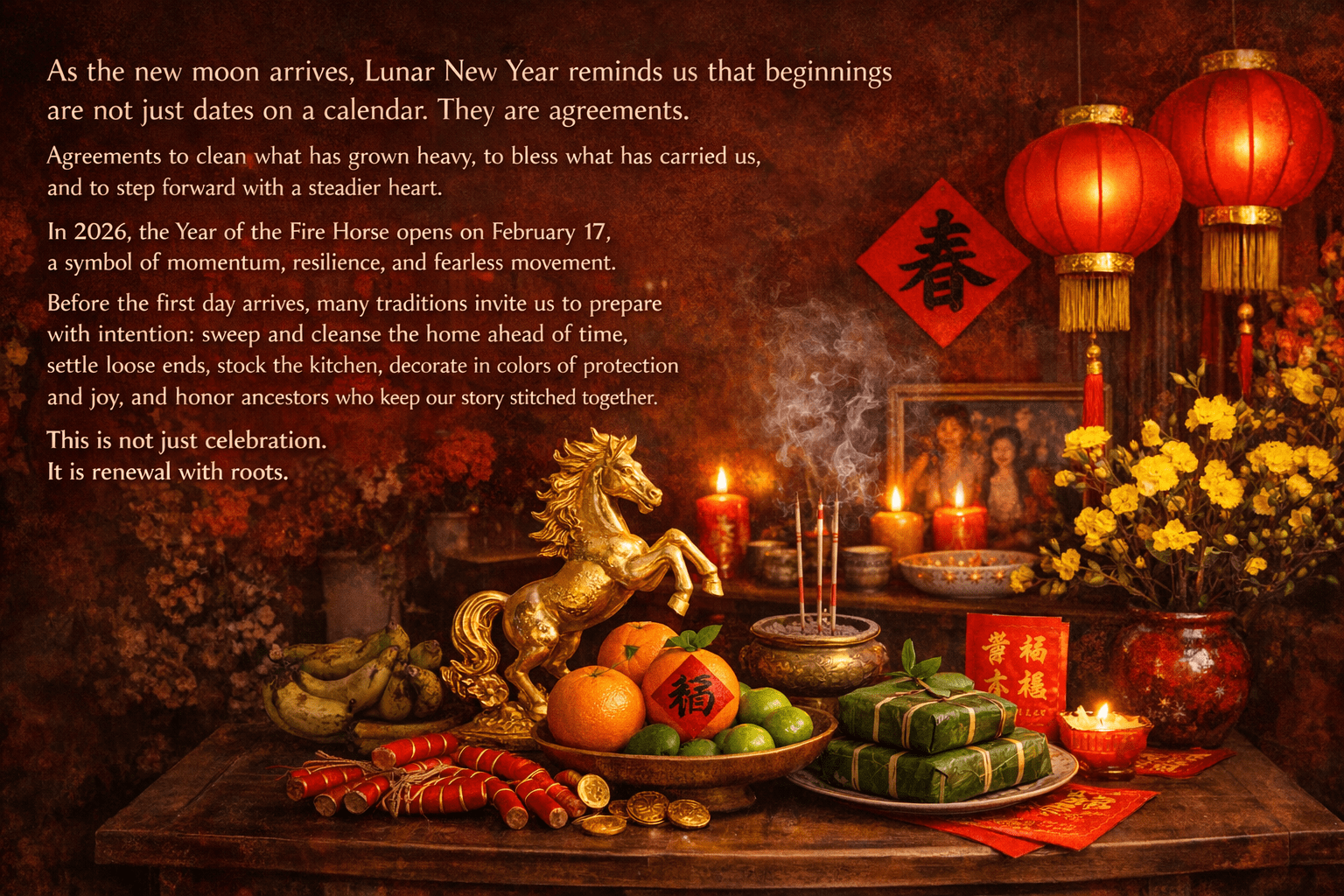
Lunar New Year is one of those holidays that refuses to be small. It is family, memory, myth, math, food, grief, hope, and a loud, joyful insistence that we get to start again.
First, a quick factual reset (because the calendar deserves respect): in 2026, Lunar New Year begins on Tuesday, February 17, and it ushers in the Year of the Fire Horse. (Smithsonian Institution) If you have seen February 16 floating around, that is likely time zone confusion or “New Year’s Eve” energy being counted as the start. The official first day is Feb 17 in 2026. (Chinese New Year)
Now for the magic and the meaning.
The holiday is often called Spring Festival in China, Tết in Vietnam, and Seollal in Korea, celebrated across East and Southeast Asia and throughout the diaspora. (AP News) It begins with the first new moon of the lunar calendar and traditionally runs about 15 days, ending with the Lantern Festival. (Smithsonian Institution) So this is not “a day.” It is a season of intention.
History: older than your group chat, and still evolving 🔥
Lunar New Year has roots stretching back thousands of years. Many historians trace early forms of it to the Shang Dynasty, when communities held year turning ceremonies and offerings honoring deities and ancestors. (Timothy S. Y. Lam Museum of Anthropology) Over time, the calendar and observances were refined, including major reforms in 104 BCE during the Han dynasty that helped standardize how “the new year” is determined. (afe.easia.columbia.edu) In other words: this is a living tradition shaped by rulers, farmers, astrologers, poets, and families trying to survive winter and welcome spring with their whole chest.
And then there are the stories. One of the most famous is the legend of Nian, a monstrous force driven away by light, loud sound, and the color red. It is myth, yes, but it is also psychology: when the world feels dangerous, humans invent rituals that remind us we are not powerless. (Wikipedia)
The Year of the Fire Horse: what it symbolizes 🔥
The Chinese zodiac cycles through 12 animals, and also through five elements (wood, fire, earth, metal, water), creating a 60 year rhythm. (Smithsonian Institution) That is why the Fire Horse is considered rare in the “big cycle.” (The Washington Post)
Smithsonian’s framing is clean and culturally grounded: 2026 is the Year of the Fire Horse, and the horse is associated with hard work, bravery, and resilience. (Smithsonian Institution)
If you want the poetic translation: Fire Horse energy is momentum with a pulse. It is freedom that refuses to whisper. It is the courage to move, especially when you have been stuck. It is also a reminder to steer your own heat. Fire can warm a home, or burn it down, depending on who is driving.
Before the New Year arrives: traditions for clearing, preparing, and blessing 🔥
Across many Lunar New Year cultures, the “before” is just as important as the “day.” It is the spiritual housekeeping. The energetic reset. The soft, serious preparation that tells your life: I am making space for better.
- Clean the home, but do it before New Year’s Day 🔥
A widely practiced tradition is deep cleaning before the new year to “sweep away the dust,” symbolically clearing out stale luck and last year’s residue. (China Highlights) The key detail is timing: many customs discourage sweeping on New Year’s Day itself because you do not want to “sweep away” incoming good fortune. (Different families interpret this differently, but the pre-holiday clean is a common thread.) (China Highlights)
Make it a ritual, not a chore: open windows if you can, play music, speak gratitude for what protected you, then release what you are done carrying.
- Finish old business: debts, apologies, loose ends 🔥
This is less “superstition” and more emotional math. The new year is a threshold, and thresholds feel cleaner when you are not dragging a thousand unfinished things behind you. Many families prioritize settling accounts, resolving conflicts, and completing tasks before the turn. (Think of it as: do not import chaos into a fresh chapter.) This theme also shows up in mainstream “before New Year” guides, alongside cleaning and preparations. (China Highlights) - New Year shopping and food prep 🔥
Stocking the kitchen is part practicality, part symbolism. Traditional guidance emphasizes shopping before the holiday for foods, snacks, decorations, and clothing, so the first days can be devoted to family, visits, and rest. (China Highlights)
If you have Southeast Asian roots, food becomes a love language with ancestral punctuation. In Vietnamese Tết traditions, making bánh chưng and bánh tét is iconic, and preparations often include a five-fruit tray on the family altar, visiting ancestors’ graves, and year-end ceremonies honoring ancestors and the earth. (Vinpearl) That is not just cuisine. That is lineage you can taste.
- Decorate with intention: red, light, welcome 🔥
Red lanterns, couplets, paper cuttings, and other decorations are common in many Chinese communities, tied to blessings for health, peace, and protection. (China Highlights) In the diaspora, the decor often becomes a blend: a red knot beside a Vietnamese hoa mai print; a Korean-inspired table setting beside a Chinese zodiac figurine. That blending is not “dilution.” It is the living tradition doing what it has always done: adapting while staying rooted. - Honor the kitchen and the hearth (Little New Year energy)🔥
In some Chinese traditions, the days about a week before Lunar New Year include “Little New Year,” associated with honoring the Kitchen God and preparing the home for the holiday. (The World of Chinese) (Dates vary by region, but it typically falls on the 23rd or 24th day of the 12th lunar month.) (The World of Chinese)
Even if your family does not observe this explicitly, the spirit is powerful: bless the place that feeds you. The hearth is not just where food is made. It is where your life gets put back together. - Prepare gifts, red envelopes, and “good-luck” gestures 🔥
Across many Lunar New Year celebrations, gifting money in red envelopes is a widespread tradition (Chinese hóngbāo; Vietnamese bao lì xì), especially for children and elders, as a gesture of blessing and good fortune. (AP News) Even if you do not follow the exact form, the principle is clear: generosity is part of the new year’s vocabulary.
A simple Velvet Horizons style blessing to share
Here is a message you can adapt for your blog or socials:
May this Lunar New Year bring you a clean beginning and a brave heart.
May the Fire Horse lend you momentum, not chaos; courage, not ego.
May your home be filled with warmth, your table with meaning, your days with people who feel like peace.
May what is finished stay finished.
May what is meant for you arrive with clarity.
Happy Lunar New Year. Gong Xi Fa Cai, Chúc Mừng Năm Mới, Saehae Bok Mani Badeuseyo. (AP News)
One last grounding note (because reality matters too): Lunar New Year is also the largest annual travel period in China, often described as the world’s biggest human migration, because people return home for reunion. (Reuters) That scale is part of the story. This holiday is not just personal. It is civilizational.
May your “before” be gentle and deliberate, and may your “after” be bright.
Discover more from Velvet Horizons
Subscribe to get the latest posts sent to your email.

